




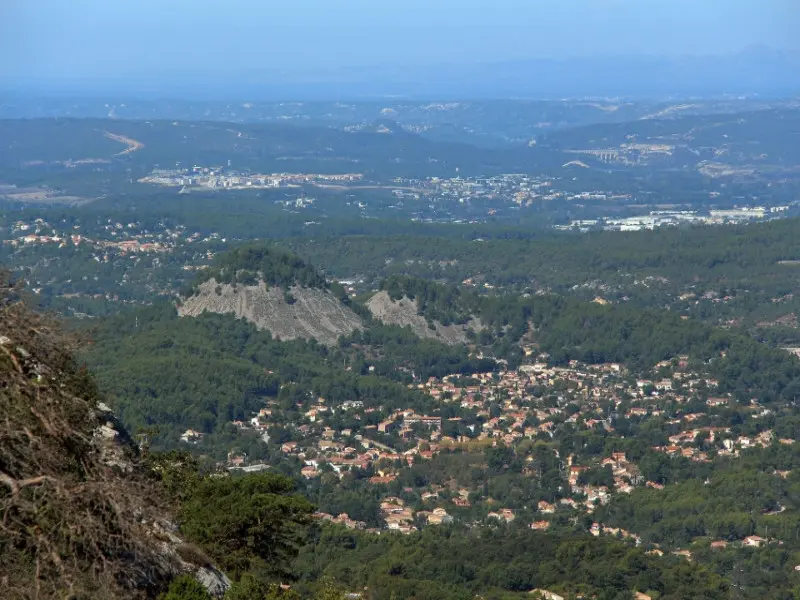

Saint-Savournin is one of the many communes that make up the Provence coalfield, of which Gardanne is perhaps the most emblematic, with the closure of the last mine shaft in February 2003. This basin stretches from the Étang de Berre in the west to the Arc valley towards Trets in the east, passing through the Chaînes de l'Estaque, de l'Etoile and de l'Huveaune in the south.
As early as the 16th century, there were coal quarries in Saint-Savournin. By the end of the 17th century, lignite was better exploited and used in cement works, tile factories, soap factories and refineries. It was also used to heat lime kilns, notably in the Valdonne area below Valentine, on the road to La Bouilladisse. Around 1790, nearly three hundred workers were employed in the Saint-Savournin mines.
In the 18th century, coal was transported to Marseille by mule. Two routes were used: the sentier du Terme (today's Allauch road after Cadolive) or, longer but safer, the old chemin d'Aix-en-Provence, which reached Aubagne via the Huveaune valley. In 1863, a railroad line was built between Aubagne and La Barque (now Fuveau) to serve the mines. In 1868, a track was opened between Aubagne and Valdonne, where a station was built in 1870. This train also carried passengers until 1939, and was definitively discontinued in 1960.
The main wells were dug between the 19th and 20th centuries:
Dubreuil well in 1820 (70 meters deep).
Saint-Pierre well in 1842 (56 meters).
Castellane well in 1844 (150 meters).
Léonie well in 1866 (203 meters).
Saint-Joseph well in 1866 (193 meters).
Notre-Dame-du-Château shaft in 1871 (250 meters).
The Armand well in 1891, finally closed in 1954.
The Germain well was inaugurated in 1927 (600 meters) and closed in 1961.
As early as the 16th century, there were coal quarries in Saint-Savournin. By the end of the 17th century, lignite was better exploited and used in cement works, tile factories, soap factories and refineries. It was also used to heat lime kilns, notably in the Valdonne area below Valentine, on the road to La Bouilladisse. Around 1790, nearly three hundred workers were employed in the Saint-Savournin mines.
In the 18th century, coal was transported to Marseille by mule. Two routes were used: the sentier du Terme (today's Allauch road after Cadolive) or, longer but safer, the old chemin d'Aix-en-Provence, which reached Aubagne via the Huveaune valley. In 1863, a railroad line was built between Aubagne and La Barque (now Fuveau) to serve the mines. In 1868, a track was opened between Aubagne and Valdonne, where a station was built in 1870. This train also carried passengers until 1939, and was definitively discontinued in 1960.
The main wells were dug between the 19th and 20th centuries:
Dubreuil well in 1820 (70 meters deep).
Saint-Pierre well in 1842 (56 meters).
Castellane well in 1844 (150 meters).
Léonie well in 1866 (203 meters).
Saint-Joseph well in 1866 (193 meters).
Notre-Dame-du-Château shaft in 1871 (250 meters).
The Armand well in 1891, finally closed in 1954.
The Germain well was inaugurated in 1927 (600 meters) and closed in 1961.